
A Strategic Case for Government Investment, Workforce Structuring, and Process Modernization
1. Global Shipbuilding Is Being Transformed — Fast and Permanently
Across the world, industrial supply chains and defense capabilities are being rapidly retooled. Global shipbuilding, in particular, is undergoing a structural transformation. This is not a temporary adjustment — it’s a permanent shift in where and how capacity is built.
The U.S. plans to scale up from five to fifty ships per year within five years. Backed by $400 million per year through 2035, it is investing aggressively in shipyard modernization, workforce development, regional technology incubators, and capital upgrades. In a major move, the U.S. government has just earmarked $8.6 billion from the BBB specifically for icebreaker construction, reinforcing the Arctic operational imperative. Russia has announced plans to spend $6.2 billion to build 1,600 ships by 2036. This is an industrial arms race—not just in ship count, but in infrastructure, efficiency, and speed.
Canada’s renewed commitment to NATO and its growing Arctic sovereignty priorities demand that we build more ships—and quickly. But the question remains: how do we scale effectively from today’s capacity?
2. Canadian Shipyards Are New — and Structurally Underdocumented
Canada’s primary shipyards are, for all practical purposes, new. New infrastructure. New programs. New approaches. Over the last decade, our industry has done the hard work of rebuilding production capability and delivering complex vessels. These are not legacy yards operating on inertia — they are modern facilities with evolving expertise.
But they are also vulnerable.
While Canada has developed real capability in recent years, the systems knowledge, production logic, and sequencing practices remain largely undocumented. The hard-won lessons from the last cycle of builds—especially those related to outfitting, block integration, and digital coordination—have not been systematically captured and transformed into reusable training content, procedural standards, or process maps.
That creates a structural risk. When international recruiters arrive offering higher salaries—and they will—they won’t just poach welders or tradespeople. They’ll target planners, production engineers, and block leads—those who understand the critical path, sequencing logic, and tacit coordination behind modular builds. When those individuals leave, so does the hard-earned knowledge—unless it’s embedded into digital playbooks, simulation-driven training, and AI-assisted knowledge systems.
This is not a failure of skill. It’s a failure of structured knowledge transfer. And it is solvable.
3. The Fallacy of Scale: More Workers Alone Won’t Build More Ships
Mainstream commentary often highlights surface-level barriers: a lack of skilled trades, a shortage of shipyards, or insufficient capital investment. These issues are real—but they are incomplete.
The real challenge isn’t how many people we have. It’s when and where their work happens.
If it takes 100 workers to build one ship in a year, do we simply hire 5,000 to build 50 ships? Of course not. That’s not how production scales. The true bottlenecks lie in late-stage rework, compounded delays, and misaligned task sequencing.
Modern shipbuilding success depends on executing work at the right phase of construction—not stacking bodies at the end of the build. When labor is loaded into the final stages to compensate for earlier delays, productivity drops significantly. Crews work slower due to congestion, overlapping trades, and limited access. As a result, the labor intensity per task increases, absorbing more workforce capacity for less output. This erodes efficiency, bloats schedules, and burns through skilled labor that could be allocated more strategically upstream.
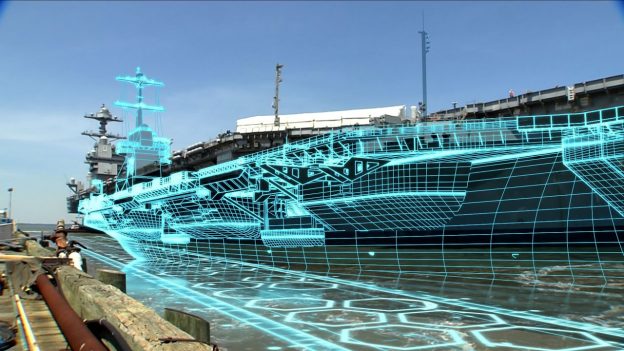
This is why block outfitting must become a national priority. Ships succeed or fail at the block stage—not at launch. Leading shipbuilding nations, including China and South Korea, already understand this. So do advanced American yards. Their approach is measured and benchmarked: blocks must reach 90% of total installation scope—validated through automated inspection tools such as laser scanning and AR overlays—before advancing. This isn’t just about planning; it’s about digitally verified execution.
Footnote: TOA (Turnover to Assembly) is a metric indicating a block has reached 90% or greater system completion before moving to the next phase.
4. Modular Construction Needs an Enforced Block Completion
Canada has adopted modular construction methods—but without a standardized performance metric, we risk undermining the benefits this approach offers. Modular construction allows for faster fabrication, parallel work streams, and more consistent quality—but only when supported by disciplined execution practices.
A nationally enforced block completion framework must be developed to ensure that each unit reaches a defined level of system, structural, and outfitting maturity before moving forward. Block completion discipline must be treated not as a yard-level best practice, but as a contractual requirement. Canada cannot continue to absorb the compounded costs of incomplete work cascading downstream. If we are to control schedules and reduce cost variability, block outfitting progress must be enforced, measured, and benchmarked at a national level. Benchmarks should draw from the Global Shipbuilding Industrial Base Benchmarking Study (GSIBBS) and similar evaluations of successful international practices.
5. Standardization and Technology Adoption Must Be Federally Led — and Deeply Integrated
Canada’s three primary shipyards currently operate using different software platforms, drawing standards, materials libraries, and installation processes. This lack of alignment creates waste, confusion across suppliers, and blocks any meaningful opportunity for shared learning or coordinated training.
A federal standardization mandate should cover:
- Design drawing conventions
- BOM and parts coding structure
- Tagging systems for materials and equipment
- Install sequencing documentation
- Quality assurance hand-off criteria
Robotics, AR, AI, and laser scanning should all be adopted as core capabilities, not future options. But these tools must be rolled out in phases, with training, digital handbooks, and planned integration—not as disconnected procurements.
6. Training Is Infrastructure—And Must Be Funded Accordingly
Digital tools only deliver value when paired with a skilled, ready workforce. The lessons from global shipbuilding leaders show that without structured training systems, even the best software or automation tools stall. Canada has the tools, the people, and the capital—but we do not yet have the national system to ensure repeatable execution.
We lack a repeatable, standards-based training infrastructure to ensure what we’ve learned from one ship is transferred to the next—and from one yard to another.
We need training that reflects:
- How work is staged for efficient block progression
- How pipe, electrical, HVAC, and structure intersect during block outfitting
- How new technology tools are deployed in real-world environments
- How supervisors assign manpower based on task complexity and interference risks
- How to translate work packages into visual, easy-to-follow install guides for tradespeople
Training must be considered infrastructure. And infrastructure must be funded, maintained, and measured.
7. A Phased, National Strategy with Yard-Specific Focus
Rather than concentrate modernization in a single shipyard, the federal government must adopt a coordinated, phased strategy that assigns core areas of innovation to each of the three major yards. A pilot yard should be selected to validate new tools, training models, and process standards before they are expanded nationally—reducing risk and ensuring practical feasibility.
- One yard may focus on advanced digital planning, block outfitting, and AR integration
- Another may lead robotics, supply chain digitization, and laser scanning
- A third may specialize in AI knowledge systems, automated logistics, and install tracking
This pilot-first approach reduces redundancy, accelerates learning, and ensures innovation is rolled out methodically. Once methods are validated and streamlined, they must be transferred horizontally to the other two yards, ensuring all three evolve together and eliminate redundant trial-and-error.
A national plan must:
- Assign innovation domains across shipyards
- Create public, shared benchmarks and KPIs
- Document and test successful methods
- Roll out proven practices with full implementation support
This isn’t just efficient—it’s nation-building. But transformation on this scale doesn’t succeed by accident. It requires intentional rollout, clear change management models, and government support to fund and monitor for long-term value. We’ve done the hard part—stood up the yards, built real ships, and shown we can deliver. Now, we must commit to structure, discipline, and shared execution models. That’s how we control budgets, deliver efficiently, and build a sovereign shipbuilding capability that lasts.
