
“Canada Needs to Build More Ships—But Not the Way We’ve Done It Before”
Introduction
Canada’s commitments to NATO, Arctic security, and maritime modernization have made one thing undeniable: we must build more ships. But matching output alone is not a strategy—especially in a global environment where peers have spent decades refining speed, cost, and precision.
The U.S., China, and South Korea are not just building more—they’re building faster, cheaper, and with far greater schedule certainty. This advantage isn’t the result of labor volume alone. It’s the outcome of deeply structured production systems, advanced modularity, and a relentless focus on process discipline.
Canada cannot compete using legacy methods built around reactive sequencing and labor backloading. If we try to scale what we’re doing now, we won’t just miss targets—we’ll institutionalize inefficiency.
Scaling Is Not a Headcount Problem
A persistent misconception in public discussion is that higher shipbuilding output requires simply scaling the workforce. If 100 workers build one ship per year, can 5,000 build 50? In theory, maybe. In practice, definitely not.
When labor is applied at the wrong time or under the wrong conditions—especially in late-stage construction—the cost per unit of work skyrockets. A task delayed from pre-outfitting to final assembly often consumes two to three times more labor and time. Multiplied across hundreds of deferred tasks, this leads to massive schedule slippage and budget overrun.
The solution isn’t more people. It’s smarter, earlier, and more structured deployment of work. Canada must shift from reactive manpower allocation to enforcing build logic at every level of execution. The future of shipbuilding here won’t be won in staffing—it will be won in sequencing.
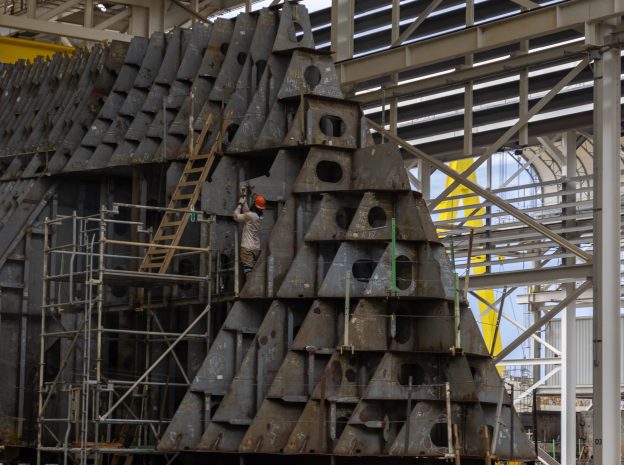
Ships Succeed—or Fail—at the Block Stage
Globally competitive yards recognize that ships are won or lost at the block level. The most effective yards aim for each block to be at least 90% outfitted before movement—measured against total planned work, not just what’s convenient to install early.
This “TOA 90%” discipline is common in Korean and Chinese yards and is gaining traction in the U.S. In contrast, Canadian yards often push block movement with incomplete systems, hoping to “catch up” later. The result: interference clashes, rework, and higher-cost corrections that drain capacity and extend builds.
Block completion must become a primary production metric—not just a best practice. Funding models should reward completion at the block level, not steel cut or physical placement alone.
To Build Efficiently, We Must Build Differently
For Canada to scale production meaningfully and sustainably, three foundational changes are needed:
- From Reactive to Proactive Sequencing: Right now, too many build plans are dictated by what’s possible, not what’s optimal. Constraint-based scheduling must give way to logic-driven sequencing that front-loads critical work before bottlenecks emerge.
- Enforce Modular Integrity: Modular construction only works when blocks are fully outfitted, interfaces are verified, and digital overlays match field execution. Partial blocks destroy sequencing flow and create compounding inefficiencies.
- National Block Completion Metrics: Until Canada establishes a standardized, enforced definition of block readiness—validated digitally and applied consistently—divergence will persist across programs and yards. Contracts must tie payment milestones and progress reports to actual block maturity.
Leadership Means Letting Go of Legacy Thinking
Canada can lead in shipbuilding—but not if we continue measuring success by headcount or tonnage alone. Leadership will come from embedding quality and precision at the right stages, not scrambling to recover it at the end.
That means changing how we plan, how we fund, and how we measure. It means rewarding sequencing discipline and penalizing cascading delays. It means teaching the next generation of builders to install once—and install right.
We need to build more ships. But we need to build them better—not bigger versions of the same old process.
This article is part of our national strategy series, based on insights from “The Next Wave: Canadian Shipbuilding in the Era of Structure, Strategy, and Industry 5.0.” Read the full report to explore how sequencing, standardization, and smart execution can transform Canadian shipbuilding at scale.